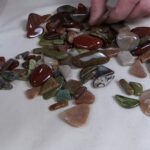
Somewhere around your third or fourth tumble batch you start noticing the tumbler’s limits. A tumbler can round and polish your stones, but it won’t reliably produce the precise outline and dome you want for a pendant. That gorgeous banded agate you spent five weeks on looks great in the pile but does not look like the polished dome you saw on Etsy.
That domed shape is a cabochon. Getting there means moving from the tumbler onto equipment that lets you shape and polish stones one at a time. This post is for tumblers who’ve hit the ceiling of what a rotary or vibratory barrel can do, and are trying to decide whether cabbing is a good next step.
What a cabochon is (and what cabbing really involves)
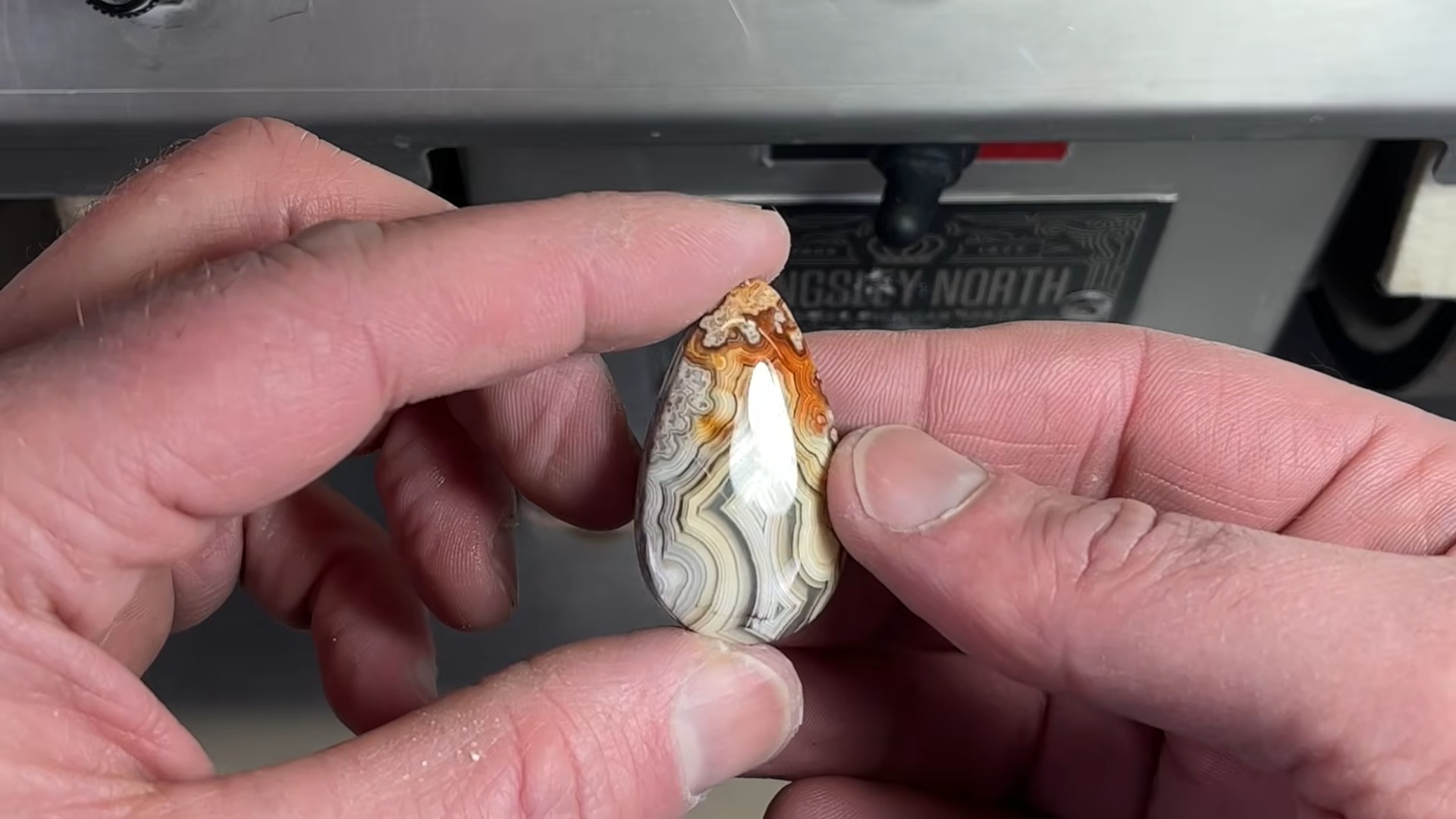
A typical cabochon has a smooth, domed top and a flat back. Double cabochons, where both sides are shaped, also exist. Not every polished stone in jewelry is a cab. Faceted stones, carvings, and inlay pieces are their own categories. Rings and pendants often use cabs, but a bezel-set stone might be anything.
Tumbling makes rocks rounded and shiny. Cabbing gives you controlled shaping and polishing: a specific outline, a specific dome curve, a specific finish. You choose the shape. You choose the polish level. And you can choose the stone’s orientation and outline to showcase a particular band or pattern.
The tools that can do controlled shaping range from hand diamond files at the low end through horizontal flat laps in the middle to multi-wheel arbor machines at the top. What they share is that you work one stone at a time, moving through progressively finer abrasives, and finishing with a polish suited to the material.
Should you make the leap?
Five yes/no questions. Answer them straight, then decide.
- Can you comfortably afford the equipment and supplies without needing sales to repay the cost?
- Do you want to shape stones for a specific purpose (jewelry, gifts, sale, or display) rather than just polish them?
- Do you have workspace that can handle water spray, splash, and drainage for 45–90 minutes at a time? (Apartments make this hard.)
- Are you willing to accept a learning period during which your first pieces will not match what you see online?
- Are you open to trying a lapidary club, evening class, or a friend’s machine before you buy?
There’s no score. Read your own answers. If most are “yes” and you can act on question 5 first, keep reading. If most are “no”, the tumbler is doing what you need and finished cabs can be bought from artisans on Etsy.
The three ways to shape a cab
Three categories to consider when stepping up from a tumbler. Price is one attribute of each; the working method matters more.
Hand methods: rotary tool plus diamond files
A suitable rotary tool and diamond files can help shape a cab; progressively finer abrasives and a compatible polishing pad and compound are needed to finish it. It’s slow, consistent shaping takes practice, but it’s the cheapest way to find out whether you enjoy the work.
Safety before you plug anything in. Do not assume a household rotary tool is suitable for wet use: follow the exact tool and accessory instructions, and never improvise a water feed around equipment not designed for it. Use appropriate dust controls and follow the equipment’s safety instructions, including any respiratory-protection requirements. Dremel’s own guidance directs users to follow the tool’s manual and electrical-safety precautions.
A decent starting file set: Diamond Hand File Set (10-piece needle files).
Flat laps
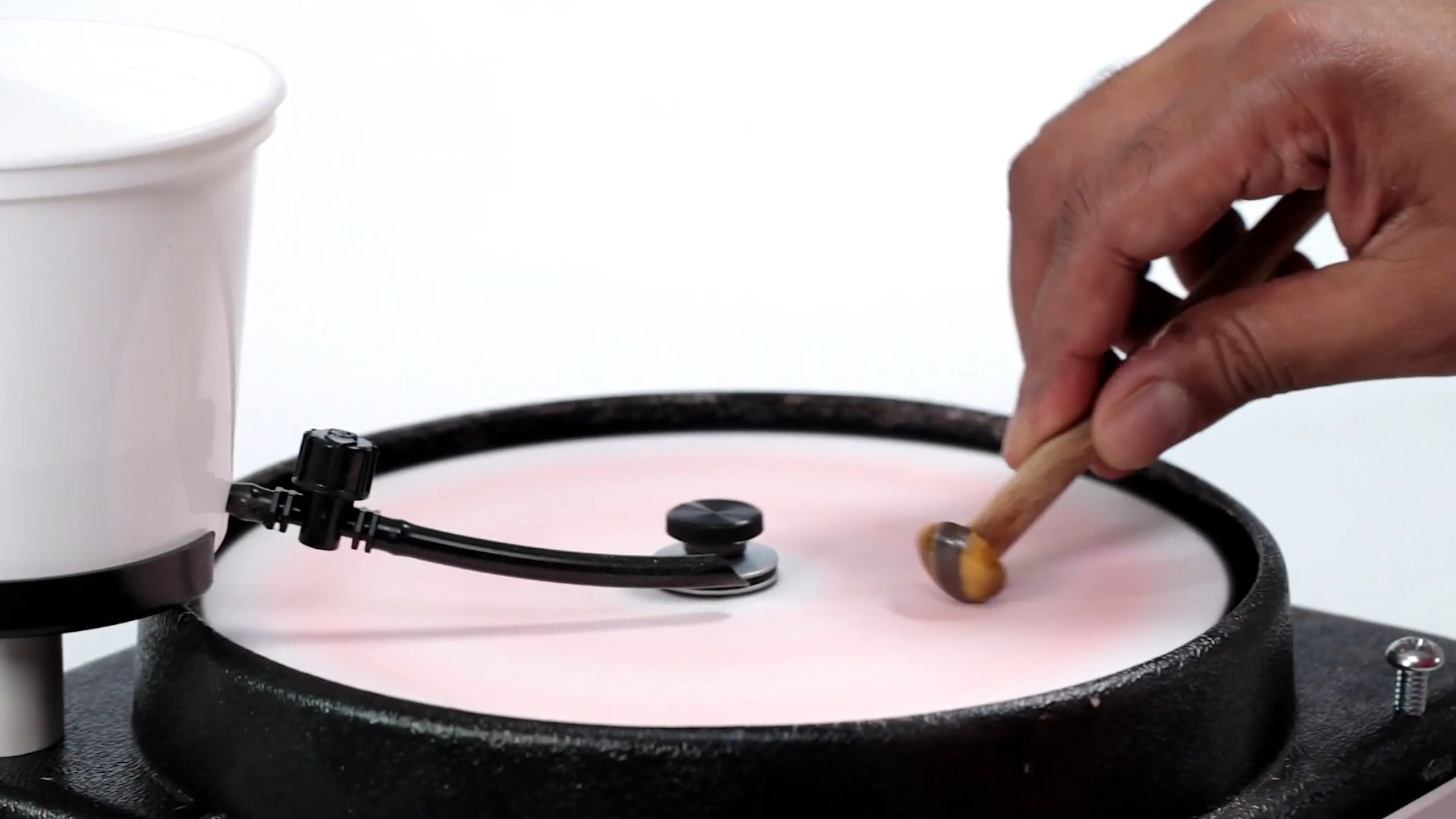
A flat lap is a machine with a horizontal spinning disc. You control the stone’s angle against the disc as you shape it, which is what lets you form a dome by hand.
The All-U-Need is one option on the beginner end of the flat-lap category. The Hi-Tech Diamond All-U-Need family uses interchangeable horizontal abrasive discs, with an adjustable water feed to keep the working surface wet. Hi-Tech currently lists this family starting around US$599 for the entry model, moving up as size and included accessories change. That price band is lower than most six-wheel machines, and the horizontal working method is a different feel. Some people find it easier to learn, some prefer the vertical wheel.
Product: Hi-Tech Diamond 6″ All-U-Need Lapidary Machine (Rock Polishing Kit).
Multi-wheel arbor machines
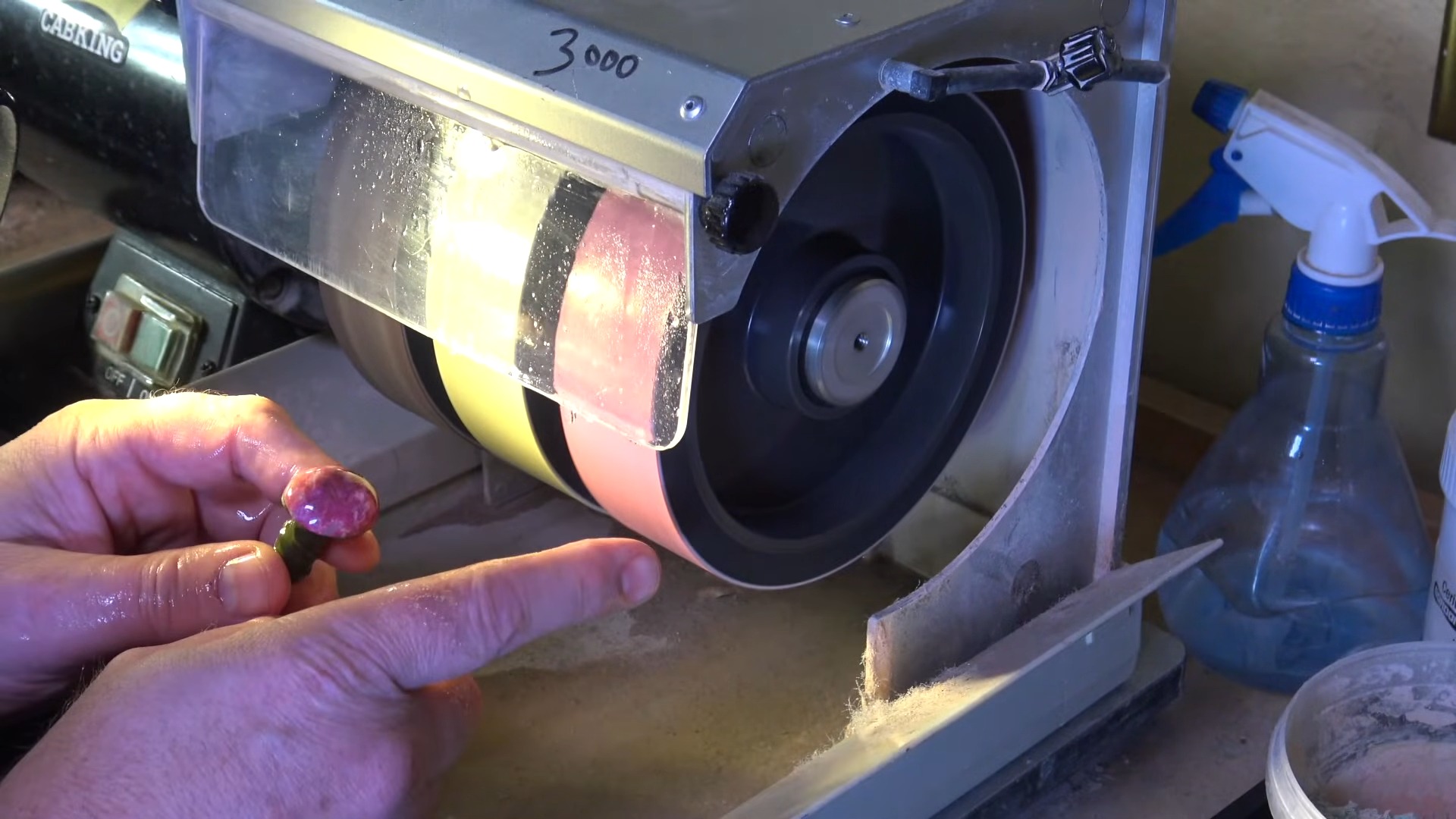
The next category is a horizontal shaft (arbor) with several diamond wheels lined up on it, each a different grit, plus a polish wheel or pad. You press the stone against each wheel in turn.
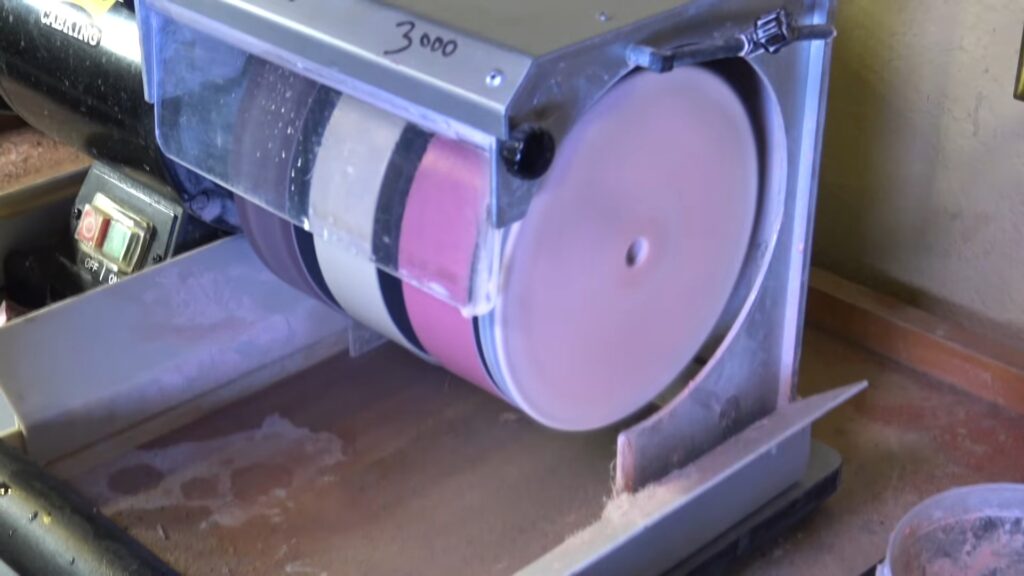
The CabKing 6V3 is one option in this category. Its six wheels are 80, 220, 280, 600, 1,200 and 3,000 grit, with the final polish done separately using 14,000-grit diamond paste on a supplied canvas pad. The machine runs at 1,800 RPM. We’d highly recommend a cleared bench area of roughly 2 × 3 feet, plus room to move behind and beside for water and rinse.
Product: CabKing 6″ V3 Cabbing Machine (Complete Grinder Polisher).
Quick comparison
 Hi-Tech Diamond All-U-Need (6″) Hi-Tech Diamond All-U-Need (6″) |  CabKing 6V3 CabKing 6V3 | |
|---|---|---|
| Type | Horizontal flat lap | Multi-wheel arbor (6 wheels) |
| Working method | Change disc for each grit | Move stone across wheels |
| Starting price (USD, manufacturer) | ~$599 for entry unit | ~$1,499 for the machine |
| Polish | 14,000-grit diamond paste on supplied Tech-11 pad | 14,000-grit diamond paste on supplied canvas pad |
| Footprint | Smaller | ~2 × 3 ft cleared bench |
| Best for | Space-constrained bench, single-disc workflow | Multi-wheel workflow, workshop bench |
What you’ll need beyond the machine
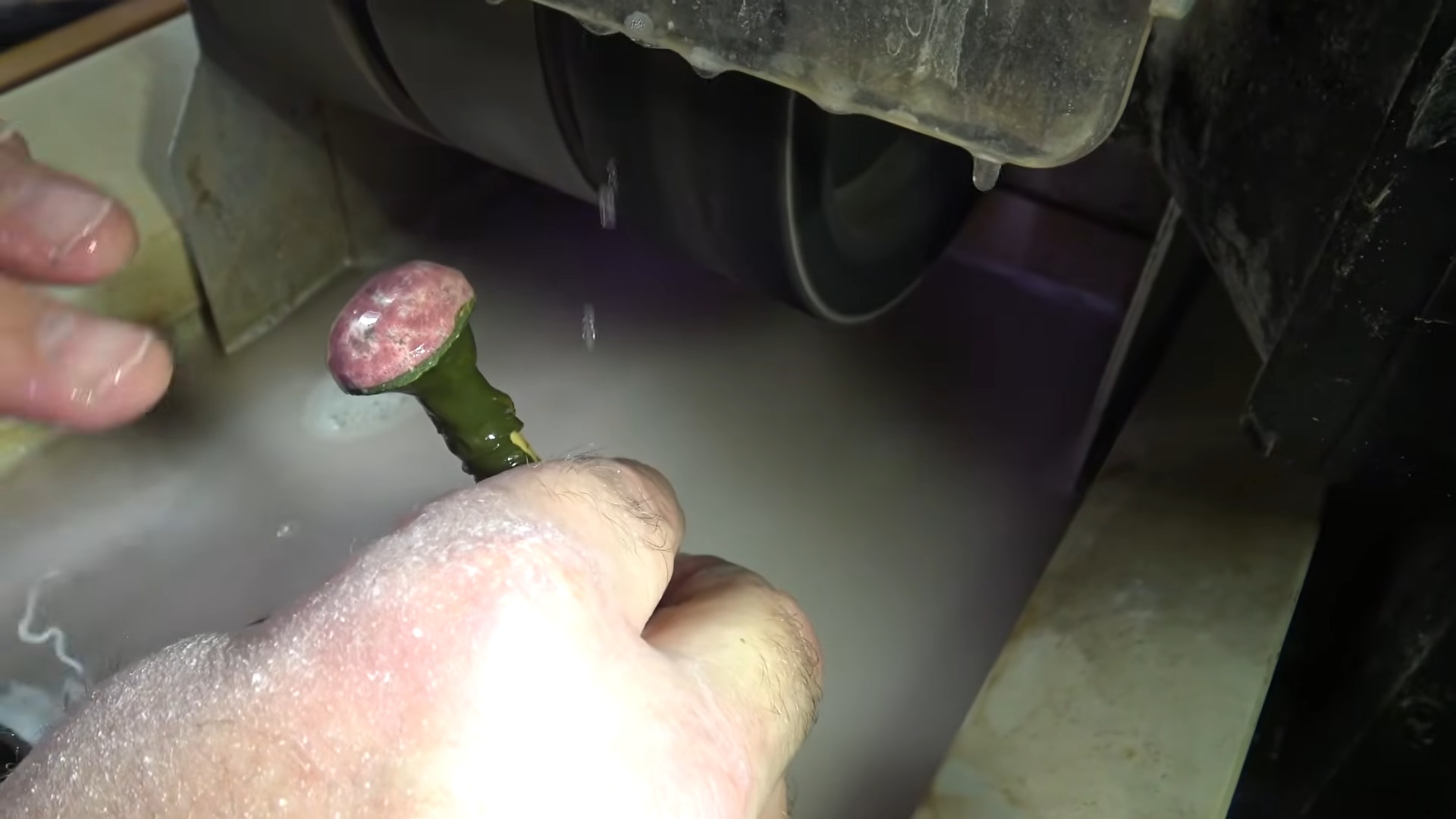
Read the included kit first. Both the Hi-Tech and the CabKing packages ship with diamond grinding and polishing supplies matched to the machine, so you don’t automatically need a separate polish compound. Buy consumables the kit doesn’t include, or replace worn ones when needed.
Common additions you’ll want either from day one or within a few sessions:
- Dopping wax and a heat source. You attach the rough stone to a wooden dowel with wax so you can hold it against the abrasive without pressing your fingers into it. Lapidary Dop Wax Sticks. A combined wax and heater unit exists too: Dop Wax Melting Pot and Stone Heater. Check what your kit includes first.
- Cerium oxide. Only if your machine’s kit doesn’t include a suitable polish AND the stones you plan to cut respond well to it. Cerium is good on quartz and some agates. It is not the right polish for every material. Fundamental Rockhound Cerium Oxide (1 lb).
- Safety glasses, a splash apron, and hearing protection.
- A cheap water bucket and a drain plan. Slurry runoff is the same principle as tumbler slurry: do not dump it down the drain, do not put it on the garden.
What tumbling teaches you that carries over
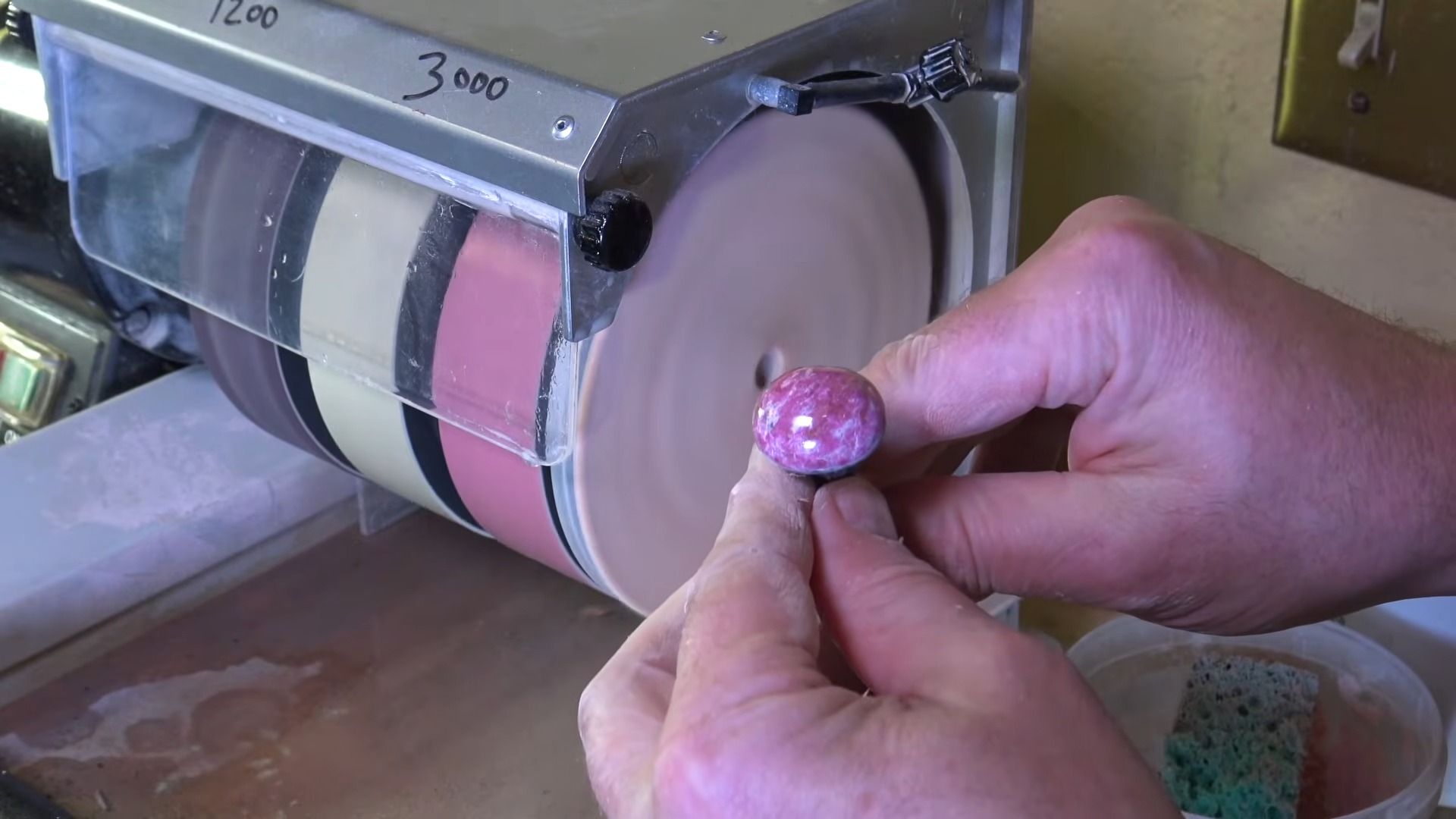
Two of the harder things about cabbing you already understand.
You know how the grit progression works. Coarse, medium, fine, polish. On a flat lap or a wheel machine, the progression is the same logic. The abrasive gets finer at each step, and it’s important to follow the recommended abrasive sequence rather than skipping stages. You know why the polish stage rewards patience.
You also know which stones are worth polishing. Mohs 6–7 material (agates, jaspers, tiger’s eye, quartz) takes a shine. Softer stones (obsidian, apache tears) can be done but need care and are unforgiving of technique errors.
The one thing tumbling does not prepare you for is directional shaping. On a tumbler you accept whatever shape the rock becomes. On a wheel or flat lap you decide the shape. That’s the new skill. How long it takes to feel natural depends on the material, the equipment, and whether you’re learning alone or with someone who’s cabbed before.
What to cut first
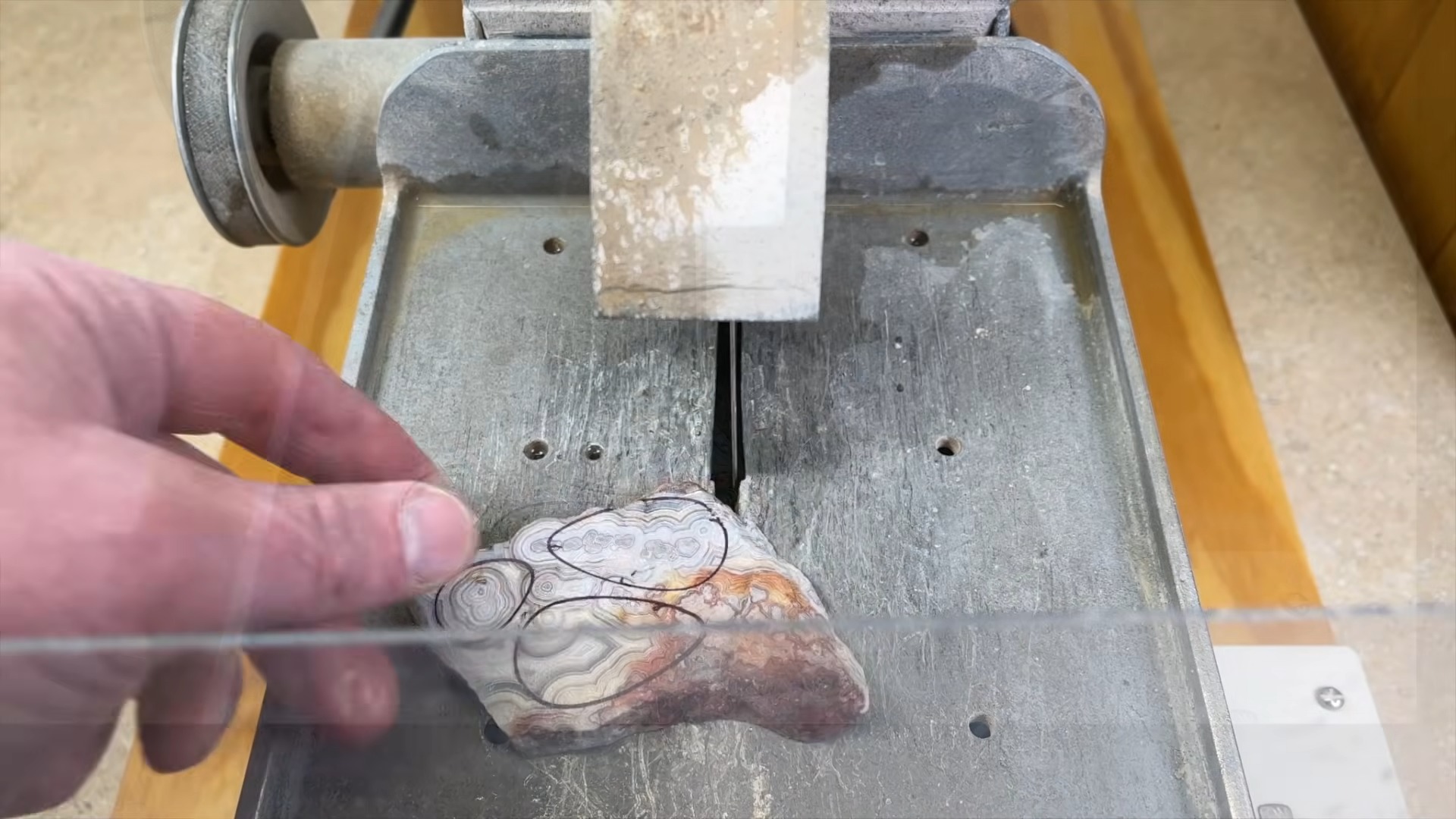
Do not start with a piece of rough you love. Start with something cheap you can afford to mess up.
Good first stones: Brazilian agate, basic red jasper, carnelian, ocean jasper offcuts. All are Mohs 6–7, take a decent polish, and are inexpensive enough on eBay and Etsy that ruining a few doesn’t sting. Save Montana agate, chrysoprase, and Mexican fire agate for later, once you’ve built confidence.
Pre-trimmed blanks or preforms (small pieces already cut and roughly outlined) are the cleanest starting point for anyone who doesn’t own a trim saw. A raw slab may still need trimming around your marked outline, and doing that on a wheel or flat lap without a saw is slow and wasteful. Look for “cabochon preforms” on Etsy or lapidary suppliers.
If you’re still on the fence
One question to close on.
Do you like the process of tumbling itself, or just the finished stones? If it’s the finished stones, cabbing gives you more control and faster feedback. If it’s the process, cabbing is a different craft rather than an upgrade.
If controlled shaping appeals to you, try a supervised session at a club or class before choosing equipment. The tumbler doesn’t retire either way. You’ll keep using it for bulk batches and for stones that don’t need shaping. Cabbing is the addition, not the replacement.
Frequently asked questions
Do I have to buy a cabbing machine to make cabochons?
No. Hand methods with a rotary tool and diamond files can shape and polish stones, and pre-trimmed blanks reduce how much shaping you need to do. It’s slower than a dedicated machine and safety around dust and electrical use with water needs care.
What’s the difference between a flat lap and a multi-wheel machine?
A flat lap is a horizontal spinning disc that you press the stone against; you change the disc (or the abrasive on it) to move through the grit progression. A multi-wheel machine has several vertical wheels on a shaft, each a different grit, so you move the stone from wheel to wheel instead of changing the abrasive. Both can produce good cabs; the working feel is different.
Can I polish a cab in my rock tumbler?
There is a documented process for tumble-polishing cabochons using appropriate media and cycle length, described by some manufacturers of tumbling equipment. It’s not the same as running the cab through a full tumble batch, which would smooth the domed shape you spent time creating. If you want to try, follow the manufacturer’s guidance for cab tumble-finishing rather than an ordinary batch cycle.